
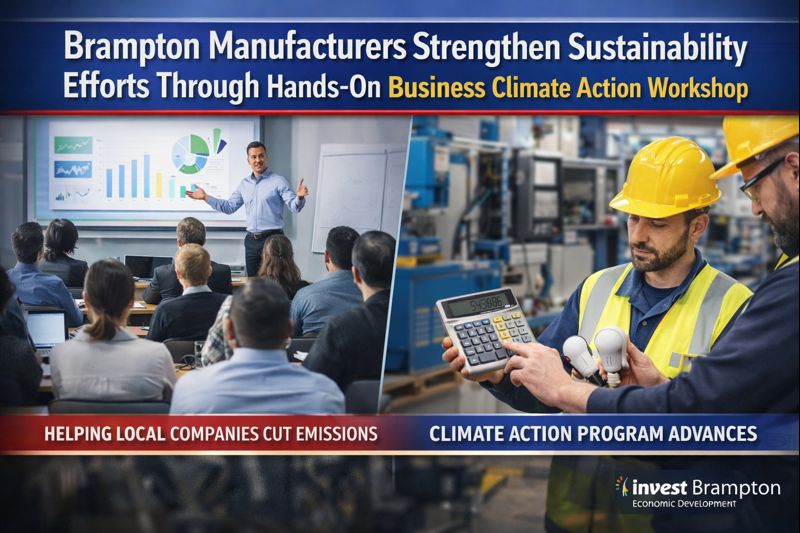
City-Led Initiative Helps Local Businesses Cut Emissions, Reduce Costs, and Build a Competitive Future
Brampton manufacturers are taking significant steps toward a more sustainable and resilient future following a collaborative business workshop designed to turn climate goals into measurable action. Hosted by the City of Brampton’s Invest Brampton – Economic Development Office in partnership with Toronto and Region Conservation Authority’s (TRCA) Partners in Project Green, the Business Climate Action Workshop brought together manufacturers from across Brampton and the Region of Peel to explore practical, cost-effective strategies for reducing emissions while improving operational performance.
Held as part of the broader Brampton Climate Action Program, the interactive session focused on equipping businesses with the tools, insights, and expert support needed to improve energy efficiency, lower operating costs, and strengthen long-term competitiveness. Organizers say the workshop reflects Brampton’s growing emphasis on supporting industry-led sustainability initiatives that deliver real economic and environmental value.
Supporting Manufacturers Through Practical Climate Solutions
The workshop was specifically designed for manufacturers seeking actionable guidance rather than high-level theory. Participants engaged in hands-on exercises, expert-led discussions, and peer learning opportunities tailored to the unique challenges faced by industrial and manufacturing operations.
A Collaborative Approach to Climate Action
By partnering with TRCA’s Partners in Project Green, the City of Brampton ensured participants had access to proven frameworks and technical expertise rooted in regional best practices. The collaboration allowed businesses to examine their own operations through a sustainability lens, identifying opportunities to reduce greenhouse-gas emissions without compromising productivity or profitability.
Representatives from Invest Brampton emphasized that supporting local manufacturers is a key pillar of the city’s economic development strategy.
“Manufacturing is a critical driver of Brampton’s economy,” city officials noted. “Helping businesses reduce costs, improve efficiency, and adapt to a low-carbon future strengthens not only individual companies, but the broader economic resilience of our city.”
Inside the Business Climate Action Workshop
The workshop brought together manufacturers from Brampton and across the Region of Peel, creating a forum for shared learning and cross-industry collaboration.
Practical Tools and Expert Guidance
Participants received practical tools to assess energy use, identify emissions hotspots, and evaluate potential improvements within their facilities. Industry experts provided guidance on energy-efficient technologies, process optimization, and operational changes that can deliver both environmental and financial benefits.
In addition to technical insights, businesses were introduced to available funding programs, incentives, and rebates designed to offset the cost of implementing sustainability initiatives. These funding pathways are often underutilized due to lack of awareness or complexity, and the workshop aimed to bridge that gap.
Learning From Local Leaders
A key feature of the session was the opportunity for participants to hear directly from companies already leading environmental change through the Brampton Climate Action Program. These real-world case studies highlighted how local manufacturers have successfully implemented climate solutions, reduced emissions, and realized measurable cost savings.
Organizers say peer-to-peer learning helped demystify sustainability efforts and demonstrated that climate action is achievable for businesses of all sizes.
Delivering Real, Measurable Impact
The outcomes of the workshop and its associated pilot program underscore the tangible value of business-focused climate action.
Identifying Emissions Reduction Opportunities
Through assessments and collaborative analysis, the initiative identified 54 distinct opportunities for participating businesses to reduce greenhouse-gas emissions. These opportunities ranged from equipment upgrades and energy-efficiency improvements to operational changes that reduce waste and energy consumption.
Collectively, the identified measures represent an estimated reduction of 86 tonnes of carbon dioxide emissions. For participating manufacturers, these reductions translate into both environmental benefits and long-term cost savings.
Unlocking Funding and Incentives
One of the most significant outcomes of the program was helping businesses access financial support to implement identified improvements. The initiative unlocked more than a quarter-million dollars in incentives and funding, reducing the upfront costs associated with sustainability upgrades.
For many manufacturers, access to funding is a critical factor in moving from planning to implementation. By connecting businesses with available programs, the workshop helped remove a common barrier to action.
“These are not abstract numbers,” organizers emphasized. “They represent real savings, real emissions reductions, and real progress for Brampton’s manufacturing sector.”
Building Operational Resilience and Competitive Advantage
Beyond immediate cost and emissions reductions, the workshop highlighted the broader business benefits of sustainability.
Strengthening Long-Term Resilience
As energy prices fluctuate and environmental regulations continue to evolve, manufacturers that invest in efficiency and emissions reduction are better positioned to adapt. Workshop facilitators emphasized that sustainability is increasingly linked to risk management, supply chain stability, and long-term operational resilience.
Participants explored how climate-smart investments can protect businesses from future cost increases while improving reliability and performance.
Enhancing Brand Value and Market Position
Sustainability is also becoming a key differentiator in the marketplace. Customers, investors, and supply-chain partners are increasingly prioritizing environmental responsibility when making decisions.
By participating in the Business Climate Action Program, manufacturers are not only improving internal operations but also strengthening their brand reputation as responsible, forward-thinking businesses.
“Being future-ready is no longer optional,” workshop leaders noted. “Sustainability is a competitive advantage.”
Celebrating Leadership in Sustainability
The workshop also served as an opportunity to recognize companies demonstrating leadership and commitment to climate action.
Leadership in Sustainability Certificate
As part of the Business Climate Action Program, participating businesses were eligible for the Leadership in Sustainability Certificate, which acknowledges organizations that have taken meaningful steps toward reducing their environmental footprint.
Congratulations were extended to Designed Precision Castings Inc. (DPCast), which was recognized for its participation and leadership in advancing sustainability initiatives. The certification highlights the company’s commitment to continuous improvement and responsible manufacturing practices.
City officials say recognizing local leaders helps inspire other businesses to take similar steps and reinforces the value of collective action.
A Growing Momentum for Climate Action in Brampton
The success of the Business Climate Action Workshop reflects a broader shift within Brampton’s business community toward proactive sustainability planning.
Aligning Economic Growth With Environmental Responsibility
Invest Brampton’s involvement underscores the city’s commitment to aligning economic development with climate objectives. By supporting manufacturers through education, partnerships, and funding access, the city aims to ensure economic growth remains both inclusive and environmentally responsible.
The partnership with TRCA’s Partners in Project Green also highlights the importance of regional collaboration in addressing climate challenges that extend beyond municipal boundaries.
Expanding the Program’s Reach
Following the strong results of the pilot initiative, organizers are exploring opportunities to expand similar workshops and support programs to reach more businesses across Brampton and the Region of Peel.
Future sessions may focus on sector-specific challenges, advanced energy solutions, or deeper technical assessments, building on the foundation established by the initial workshop.
Conclusion: Turning Climate Goals Into Business Success
The Business Climate Action Workshop demonstrated that sustainability and economic performance can go hand in hand. By providing manufacturers with practical tools, expert guidance, and access to funding, the City of Brampton and its partners have helped local businesses turn climate ambitions into concrete results.
With dozens of emissions-reduction opportunities identified, significant funding unlocked, and local leaders recognized for their efforts, the initiative has delivered meaningful impact for Brampton’s manufacturing sector.
As more businesses embrace climate-smart practices, Brampton continues to position itself as a city where innovation, sustainability, and economic growth move forward together.
Leave a Reply