
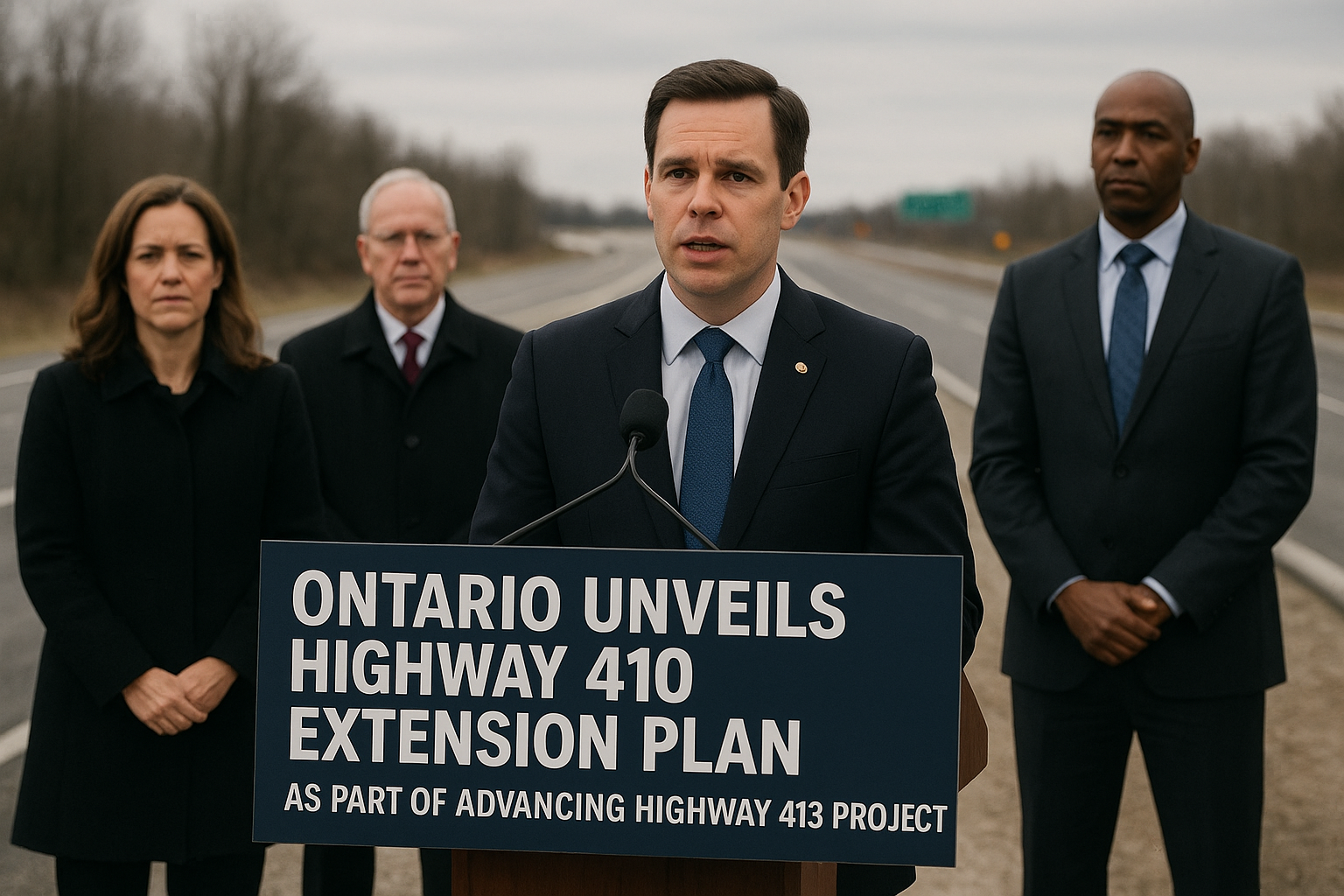
The Ontario government is moving forward with a major transportation initiative that has long sparked discussion across the Greater Toronto Area: the controversial Highway 413. As part of the broader project, provincial officials have introduced a new plan to extend Highway 410 northward, creating a direct connection between Brampton, Caledon, and the future Highway 413 corridor.
The announcement marks a significant step in the province’s efforts to address regional congestion, improve goods movement, and expand infrastructure to meet the needs of rapidly growing communities. But it also reinforces the ongoing debate surrounding the environmental and planning implications of the larger Highway 413 proposal.
Province Seeks Proposals for 9.1-Kilometre Highway Extension
During a press conference in Caledon on December 9, Ontario’s Minister of Transportation, Prabmeet Sarkaria, confirmed that the province is now seeking formal proposals to design the upcoming Highway 410 extension. The 9.1-kilometre stretch would run from the current terminus of Highway 410 at Countryside Drive in Brampton, continuing north to meet the planned Highway 413 and west toward Highway 10 in Caledon.
A New Link Between Two Major Corridors
If completed, the extension would create a new north–south connection feeding directly into the proposed Highway 413, a 52-kilometre route intended to link Highway 400 in the east with the Highway 401/407 interchange in the west. The Ministry of Transportation noted in its announcement that this connection is expected to streamline travel across York, Halton, and Peel regions, offering both commuters and commercial drivers an alternative to heavily congested local roadways.
In a statement distributed shortly after the event, the ministry highlighted the potential benefits of the planned extension: “This extension will give drivers a direct link between the two highways, cutting travel times and relieving gridlock on local roads.”
This direct link is considered a strategic component of the larger Highway 413 network, which—if constructed—would provide a new high-capacity corridor designed to support long-term population growth and economic expansion throughout the western GTA.
Caledon Leadership Welcomes the Move
Caledon Mayor Annette Groves expressed clear support for both the Highway 413 project and the Highway 410 extension, emphasizing that the local community stands to gain from the improvements in regional mobility. With Caledon experiencing significant development pressures and ongoing transportation challenges, municipal leaders have frequently called for infrastructure investments that can accommodate the area’s expanding population.
Expected Relief for Congested Local Roads
In her written remarks, Mayor Groves noted that the extension will “help ease local traffic congestion,” specifically highlighting the strain on Highway 10 through Valleywood and Caledon Village.
“The Hwy. 413 corridor will be a big help for our villages by supporting the extension of Hwy. 410 and easing traffic congestion on Hwy. 10,” she said. Groves also indicated that the project will complement ongoing efforts to extend Highway 427 further north, which she believes will reduce the volume of heavy trucks currently using Highway 50 to bypass congested routes.
Commitment to Community Impact Mitigation
While supporting the province’s push to advance the project, Groves also stressed that Caledon officials will work closely with provincial partners to reduce potential impacts on local communities. She stated that Caledon staff will “make every effort” to support the project’s success while ensuring that environmental, agricultural, and residential concerns are addressed through careful planning and consultation.
Highway 413: A Project Still Surrounded by Debate
Although provincial leaders continue to advance the Highway 413 and related extensions, the plan remains highly controversial. Supporters argue that the highway will play a vital role in supporting economic growth, strengthening supply chains, and relieving pressure on existing corridors such as Highways 401 and 407. Opponents, however, have raised concerns about the project’s environmental footprint, potential loss of farmland, and long-term costs.
A Major Economic Driver, According to the Province
The Ontario government maintains that Highway 413 will significantly boost the province’s economy, estimating that it will contribute more than $1 billion annually to Ontario’s gross domestic product once operational. Officials also highlight the projected time savings for commuters, with estimates suggesting that the route could reduce travel times by up to 30 minutes per trip.
For logistics companies, manufacturers, and agricultural producers in the region, these projected time efficiencies could translate into substantial improvements in productivity and supply chain reliability.
Environmental and Planning Concerns
Despite the economic arguments, critics—including environmental groups, urban planners, and some municipal leaders—have warned that the project could lead to the loss of ecologically sensitive lands, impact wildlife habitats, and encourage unsustainable patterns of suburban sprawl. Concerns have also been raised about the future highway’s alignment, which cuts through sections of the Greenbelt and prime agricultural areas.
Nonetheless, the provincial government has remained committed to the project, framing it as a necessary response to projected transportation demands and population expansion over the next several decades.
What the Highway 410 Extension Means for the Region
The planned extension represents more than just a new stretch of road; it signals a broader provincial strategy to transform regional transportation networks. If approved and constructed, the extension will play a central role in shaping future travel patterns and economic development between Brampton, Caledon, and the wider GTA.
Supporting Population Growth
Both Brampton and Caledon have experienced rapid population increases in recent years, and provincial forecasts indicate continued growth well into the future. Expanding highway capacity is seen by the Ontario government as a necessary step to accommodate rising demand.
The new 410 extension is expected to serve as an essential connector between existing urban centres and future development areas in Caledon, many of which are slated for residential and commercial expansion under local growth plans.
Enhancing Goods Movement
With Peel Region operating as one of Canada’s leading logistics hubs, efficient freight movement remains a top priority for the provincial government. The combined network of Highway 413 and the Highway 410 extension is anticipated to provide improved access for commercial vehicles, reducing bottlenecks on routes commonly used by transport trucks.
Mayor Groves’s comments regarding the anticipated reduction in truck volumes on Highway 50 further underscore the potential benefits for both safety and road quality.
Next Steps in the Planning Process
The province’s request for proposals marks the beginning of a formal design process for the extension. The government will evaluate submissions from qualified engineering and planning firms, with the selected team responsible for developing alignment options, preliminary designs, and detailed cost estimates.
Public consultation, environmental review processes, and collaboration with local municipalities—including Brampton and Caledon—will occur throughout the planning stages.
Conclusion: A Significant Transportation Investment With Broad Implications
The Ontario government’s decision to move ahead with the Highway 410 extension reinforces its commitment to expanding transportation infrastructure across the Greater Toronto Area. While the broader Highway 413 project continues to provoke debate, the latest announcement signals the province’s intent to deliver long-term solutions aimed at easing congestion, supporting economic growth, and preparing for future population increases.
As planning progresses and public discussions continue, the Highway 410 extension will remain a central component of Ontario’s evolving transportation landscape—one that will shape travel, development, and community planning for decades to come.
Leave a Reply